Invisible Induction Cooktops 2026: The Kitchen Trend Taking Over Instagram (Complete Guide) | CooktopShopCooktopShop
✦ Kitchen Design Trend · 2026 Complete Guide
The Invisible Induction Cooktop: The Kitchen Trend Taking Over America
No visible appliance. No cutout in the countertop. Just a seamless marble surface — that cooks. We break down the technology, true costs, and who should actually buy one.
By CooktopShop Editorial Team · May 6, 2026 · 14 min read
CooktopShop Editorial||Updated monthly
“The invisible cooktop doesn’t just change how you cook — it eliminates the idea that the cooktop exists at all. It’s the most significant kitchen design shift since the open-plan layout.”
It started appearing on Instagram reels in late 2024: a perfectly clean marble countertop, no appliances visible, and someone placing a pot on the surface — which promptly begins to boil. Comments exploded. “How???” “This can’t be real.” “I need this immediately.”
By 2026, invisible induction cooktops have moved from viral novelty to the defining trend of the luxury kitchen remodel market. Here’s everything you need to know before you spend $4,000–$9,000 on one.
What Is an Invisible Induction Cooktop, Actually?
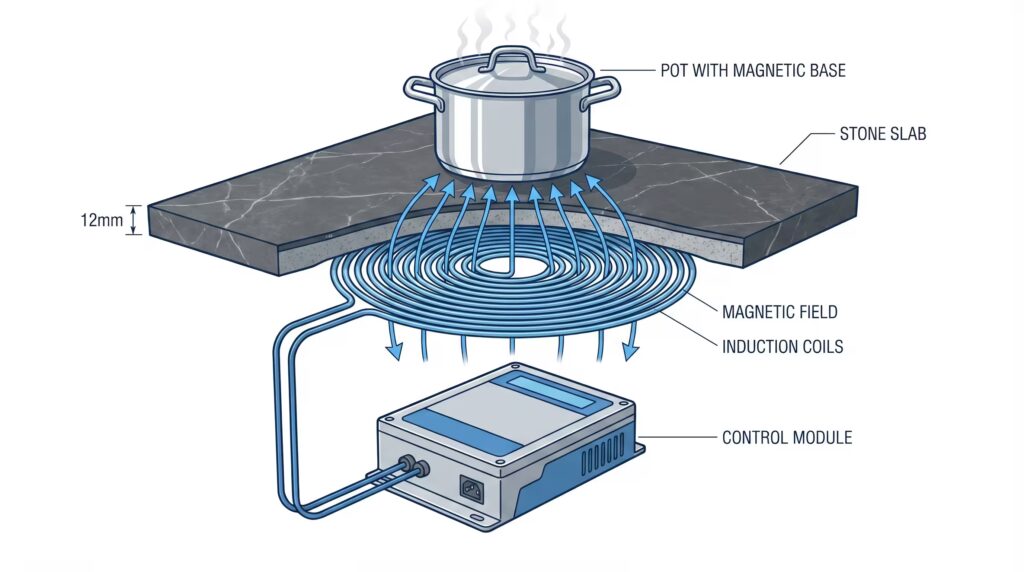
An invisible cooktop is exactly what it sounds like: an induction heating system installed beneath your countertop surface. There is no appliance visible from above. The induction coils — the same electromagnetic technology used in regular induction cooktops — are mounted in the cabinetry below a specialized countertop slab, generating magnetic fields that pass through the stone and heat your magnetic cookware.
The key word is “specialized.” You cannot install this system under standard granite, quartz, or marble. The thermal stress from induction heating will crack most natural and engineered stone. You need an ultra-compact sintered surface: materials like Dekton (by Cosentino), XTONE (by Porcelanosa), or Laminam that are engineered to handle rapid thermal cycles without fracturing.
How It Works: The Technology Explained
🧲Step 1
Coils Generate Magnetic Field
Induction coils mounted beneath the countertop generate an alternating electromagnetic field that passes through the stone slab above.
🍳Step 2
Cookware Intercepts the Field
When a magnetic (ferromagnetic) pot or pan is placed on the cooking zone, the field induces eddy currents directly inside the pan’s base, generating heat from within the metal itself.
✨Step 3
Stone Stays Cool, Food Cooks
The countertop surface only absorbs residual heat from the hot pan — it does not heat itself. The area around the pan remains cool enough to touch during cooking.
💡
Performance vs. Regular Induction
Invisible cooktops perform nearly identically to standard induction on boil time and simmer precision. The additional 12mm of stone between coil and pan causes only a 5–8% reduction in efficiency — imperceptible in everyday cooking.
The True Cost of an Invisible Induction Cooktop in 2026
This is where most blog posts fail you. They quote the hardware price and stop. Here’s the complete picture:
💰 Complete Installation Cost Breakdown (2026, US Market)
Induction Hardware (2-burner system)
Entry-level invisible cooktop unit
$1,200 – $1,700
Induction Hardware (4-burner system)
Most popular residential choice
$2,500 – $3,200
Induction Hardware (5-burner / premium)
Large island configurations
$3,500 – $4,500+
Specialized Countertop Slab
Dekton, XTONE, or Laminam — required, cannot use standard stone
$2,000 – $4,000
Professional Installation
Cabinetry work, mounting, electrical connections
$500 – $1,500
Electrical Circuit (if needed)
Dedicated 240V/50A circuit if not already present
$200 – $800
Ventilation (downdraft or ceiling flush)
Required — cooking still produces steam and odors
$400 – $2,000
Total Estimated Investment
$4,200 – $9,000+
Compatible Countertop Materials: What Works and What Cracks
✅
Dekton (Cosentino)
Compatible
The #1 choice. Ultra-compact sintered surface, zero porosity, thermal shock resistant to 600°F+. Available in 12mm thickness required for invisible cooktops.
✅
XTONE (Porcelanosa)
Compatible
Sintered porcelain slab, 12mm. Excellent thermal performance. Beautiful natural stone look with consistent patterning.
✅
Laminam
Compatible
Italian sintered ceramic at 12mm. Thin-slab aesthetic with excellent electromagnetic transparency and thermal resistance.
❌
Granite (natural)
Not Compatible
Natural fissures and mineral inclusions create stress concentration points. Thermal cycling will cause cracking within months.
❌
Standard Quartz (Silestone, Caesarstone)
Not Compatible
Resin binders in engineered quartz degrade under repeated thermal stress. Risk of cracking and resin discoloration.
❌
Marble (natural)
Not Compatible
Calcite composition is highly susceptible to thermal shock. Absolutely do not install beneath marble, regardless of thickness.
Brand Comparison: Invisacook vs BORA vs Novy
Brand
Origin
Zones Available
US Availability
Price Range (hardware)
Warranty
InvisacookMost Popular US
Australia
2–5 zones
✅ Wide
$1,200–$4,200
2 years
BORA
Germany
2–4 zones
✅ Growing
$2,800–$5,500
3 years
Novy
Belgium
2–4 zones
⚡ Limited
$2,200–$4,800
2 years
Durastone
USA
2–3 zones
✅ Direct US
$1,800–$3,600
2 years
Who Should Buy an Invisible Induction Cooktop?
✓ Buy It If…
You’re doing a full kitchen remodel and can spec the countertop from scratch
You want the absolute pinnacle of kitchen aesthetics
Your kitchen budget is $15,000+
You want a fully multipurpose island (cook, prep, dine in one surface)
You’re building a spec home in a luxury market
You’ve already budgeted for Dekton/XTONE countertops
✗ Wait If…
You have existing countertops you love and don’t want to replace
Your kitchen budget is under $10,000 total
You’re a renter or plan to move within 5 years
You want to keep your cookware options open (includes aluminum)
You want easy repairs if a zone fails
You prefer a visible confirmation that the cooktop is on
⭐ Our Verdict
The invisible induction cooktop is one of the most genuinely exciting kitchen innovations in 20 years. For the right project — a ground-up kitchen remodel with a generous budget — it delivers an aesthetic that simply cannot be replicated by any visible appliance. But it’s a full kitchen investment, not just an appliance swap. If you’re not replacing the countertops anyway, the economics don’t make sense. Budget at minimum $6,000 and get at least three installation quotes before committing.
An invisible induction cooktop is an induction heating system mounted beneath a specialized countertop surface — typically 12mm Dekton or sintered porcelain. There’s no visible appliance: place a magnetic pot on a marked zone on your countertop and it heats. The technology is completely hidden beneath the stone.
How much does an invisible induction cooktop cost in 2026?
Complete installation costs range from $4,200 to $9,000+. Hardware: $1,200–$4,500. The required specialized countertop slab: $2,000–$4,000. Installation: $500–$1,500. Electrical if needed: $200–$800. Ventilation: $400–$2,000. Budget at minimum $6,000 for a realistic 4-zone installation.
Can I install an invisible induction cooktop under my existing quartz countertop?
No. Standard quartz contains resin binders that degrade under repeated thermal stress from induction cooking. You need an ultra-compact sintered surface such as Dekton, XTONE, or Laminam at 12mm thickness. Any installation under standard granite, quartz, or marble will eventually crack the countertop.
What happens if my invisible cooktop breaks? Do I lose the countertop?
No. The induction units are mounted in the cabinetry beneath the countertop and accessed from below. A technician can reach, repair, or replace a failed unit without disturbing the stone surface above. This is a common concern but not a real issue in practice.
Do I still need a range hood with an invisible induction cooktop?
Yes, absolutely. Cooking still produces steam, grease, and odors regardless of the cooktop type. Most invisible cooktop installations pair with either a ceiling-flush extractor or a pop-up downdraft vent that retracts into the counter when not in use — maintaining the seamless aesthetic.