Invisible Induction Cooktops 2026: The Kitchen Trend Taking Over Instagram (Complete Guide) | CooktopShopCooktopShop
✦ Kitchen Design Trend · 2026 Complete Guide
The Invisible Induction Cooktop: The Kitchen Trend Taking Over America
No visible appliance. No cutout in the countertop. Just a seamless marble surface — that cooks. We break down the technology, true costs, and who should actually buy one.
By CooktopShop Editorial Team · May 6, 2026 · 14 min read
CooktopShop Editorial||Updated monthly
“The invisible cooktop doesn’t just change how you cook — it eliminates the idea that the cooktop exists at all. It’s the most significant kitchen design shift since the open-plan layout.”
It started appearing on Instagram reels in late 2024: a perfectly clean marble countertop, no appliances visible, and someone placing a pot on the surface — which promptly begins to boil. Comments exploded. “How???” “This can’t be real.” “I need this immediately.”
By 2026, invisible induction cooktops have moved from viral novelty to the defining trend of the luxury kitchen remodel market. Here’s everything you need to know before you spend $4,000–$9,000 on one.
What Is an Invisible Induction Cooktop, Actually?
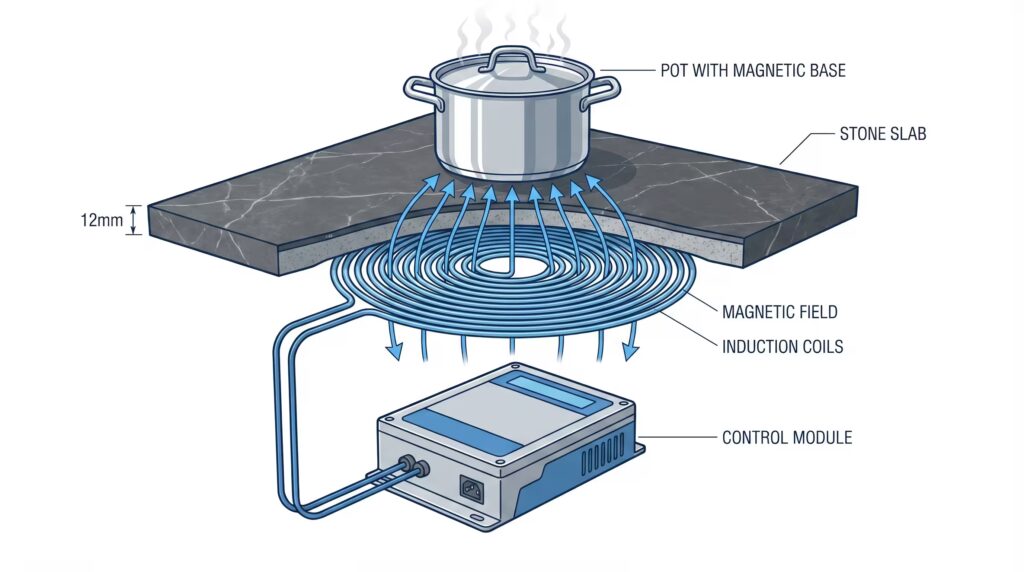
An invisible cooktop is exactly what it sounds like: an induction heating system installed beneath your countertop surface. There is no appliance visible from above. The induction coils — the same electromagnetic technology used in regular induction cooktops — are mounted in the cabinetry below a specialized countertop slab, generating magnetic fields that pass through the stone and heat your magnetic cookware.
The key word is “specialized.” You cannot install this system under standard granite, quartz, or marble. The thermal stress from induction heating will crack most natural and engineered stone. You need an ultra-compact sintered surface: materials like Dekton (by Cosentino), XTONE (by Porcelanosa), or Laminam that are engineered to handle rapid thermal cycles without fracturing.
How It Works: The Technology Explained
🧲Step 1
Coils Generate Magnetic Field
Induction coils mounted beneath the countertop generate an alternating electromagnetic field that passes through the stone slab above.
🍳Step 2
Cookware Intercepts the Field
When a magnetic (ferromagnetic) pot or pan is placed on the cooking zone, the field induces eddy currents directly inside the pan’s base, generating heat from within the metal itself.
✨Step 3
Stone Stays Cool, Food Cooks
The countertop surface only absorbs residual heat from the hot pan — it does not heat itself. The area around the pan remains cool enough to touch during cooking.
💡
Performance vs. Regular Induction
Invisible cooktops perform nearly identically to standard induction on boil time and simmer precision. The additional 12mm of stone between coil and pan causes only a 5–8% reduction in efficiency — imperceptible in everyday cooking.
The True Cost of an Invisible Induction Cooktop in 2026
This is where most blog posts fail you. They quote the hardware price and stop. Here’s the complete picture:
💰 Complete Installation Cost Breakdown (2026, US Market)
Induction Hardware (2-burner system)
Entry-level invisible cooktop unit
$1,200 – $1,700
Induction Hardware (4-burner system)
Most popular residential choice
$2,500 – $3,200
Induction Hardware (5-burner / premium)
Large island configurations
$3,500 – $4,500+
Specialized Countertop Slab
Dekton, XTONE, or Laminam — required, cannot use standard stone
$2,000 – $4,000
Professional Installation
Cabinetry work, mounting, electrical connections
$500 – $1,500
Electrical Circuit (if needed)
Dedicated 240V/50A circuit if not already present
$200 – $800
Ventilation (downdraft or ceiling flush)
Required — cooking still produces steam and odors
$400 – $2,000
Total Estimated Investment
$4,200 – $9,000+
Compatible Countertop Materials: What Works and What Cracks
✅
Dekton (Cosentino)
Compatible
The #1 choice. Ultra-compact sintered surface, zero porosity, thermal shock resistant to 600°F+. Available in 12mm thickness required for invisible cooktops.
✅
XTONE (Porcelanosa)
Compatible
Sintered porcelain slab, 12mm. Excellent thermal performance. Beautiful natural stone look with consistent patterning.
✅
Laminam
Compatible
Italian sintered ceramic at 12mm. Thin-slab aesthetic with excellent electromagnetic transparency and thermal resistance.
❌
Granite (natural)
Not Compatible
Natural fissures and mineral inclusions create stress concentration points. Thermal cycling will cause cracking within months.
❌
Standard Quartz (Silestone, Caesarstone)
Not Compatible
Resin binders in engineered quartz degrade under repeated thermal stress. Risk of cracking and resin discoloration.
❌
Marble (natural)
Not Compatible
Calcite composition is highly susceptible to thermal shock. Absolutely do not install beneath marble, regardless of thickness.
Brand Comparison: Invisacook vs BORA vs Novy
Brand
Origin
Zones Available
US Availability
Price Range (hardware)
Warranty
InvisacookMost Popular US
Australia
2–5 zones
✅ Wide
$1,200–$4,200
2 years
BORA
Germany
2–4 zones
✅ Growing
$2,800–$5,500
3 years
Novy
Belgium
2–4 zones
⚡ Limited
$2,200–$4,800
2 years
Durastone
USA
2–3 zones
✅ Direct US
$1,800–$3,600
2 years
Who Should Buy an Invisible Induction Cooktop?
✓ Buy It If…
You’re doing a full kitchen remodel and can spec the countertop from scratch
You want the absolute pinnacle of kitchen aesthetics
Your kitchen budget is $15,000+
You want a fully multipurpose island (cook, prep, dine in one surface)
You’re building a spec home in a luxury market
You’ve already budgeted for Dekton/XTONE countertops
✗ Wait If…
You have existing countertops you love and don’t want to replace
Your kitchen budget is under $10,000 total
You’re a renter or plan to move within 5 years
You want to keep your cookware options open (includes aluminum)
You want easy repairs if a zone fails
You prefer a visible confirmation that the cooktop is on
⭐ Our Verdict
The invisible induction cooktop is one of the most genuinely exciting kitchen innovations in 20 years. For the right project — a ground-up kitchen remodel with a generous budget — it delivers an aesthetic that simply cannot be replicated by any visible appliance. But it’s a full kitchen investment, not just an appliance swap. If you’re not replacing the countertops anyway, the economics don’t make sense. Budget at minimum $6,000 and get at least three installation quotes before committing.
An invisible induction cooktop is an induction heating system mounted beneath a specialized countertop surface — typically 12mm Dekton or sintered porcelain. There’s no visible appliance: place a magnetic pot on a marked zone on your countertop and it heats. The technology is completely hidden beneath the stone.
How much does an invisible induction cooktop cost in 2026?
Complete installation costs range from $4,200 to $9,000+. Hardware: $1,200–$4,500. The required specialized countertop slab: $2,000–$4,000. Installation: $500–$1,500. Electrical if needed: $200–$800. Ventilation: $400–$2,000. Budget at minimum $6,000 for a realistic 4-zone installation.
Can I install an invisible induction cooktop under my existing quartz countertop?
No. Standard quartz contains resin binders that degrade under repeated thermal stress from induction cooking. You need an ultra-compact sintered surface such as Dekton, XTONE, or Laminam at 12mm thickness. Any installation under standard granite, quartz, or marble will eventually crack the countertop.
What happens if my invisible cooktop breaks? Do I lose the countertop?
No. The induction units are mounted in the cabinetry beneath the countertop and accessed from below. A technician can reach, repair, or replace a failed unit without disturbing the stone surface above. This is a common concern but not a real issue in practice.
Do I still need a range hood with an invisible induction cooktop?
Yes, absolutely. Cooking still produces steam, grease, and odors regardless of the cooktop type. Most invisible cooktop installations pair with either a ceiling-flush extractor or a pop-up downdraft vent that retracts into the counter when not in use — maintaining the seamless aesthetic.
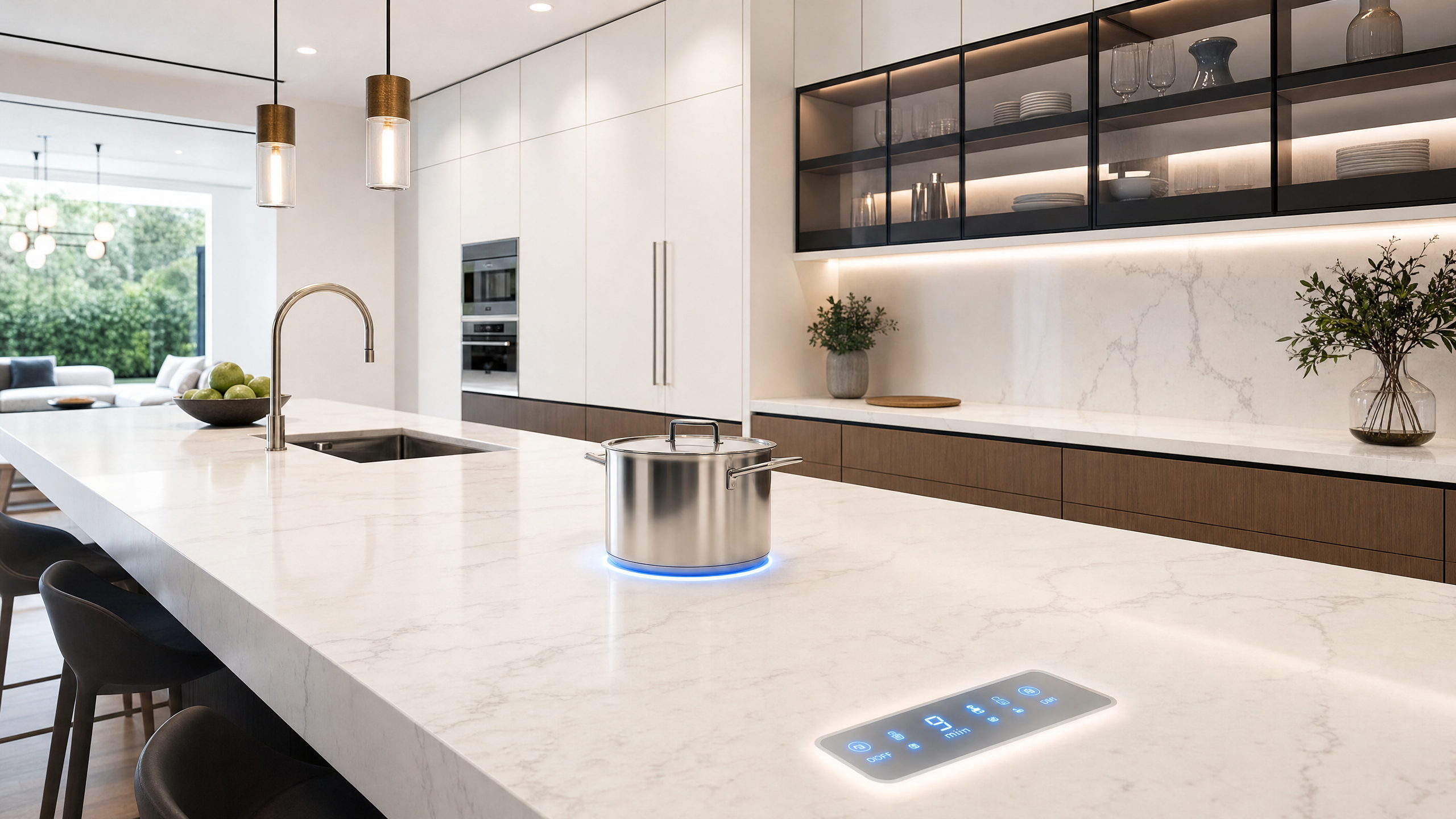
An ultra-modern luxury kitchen featuring an invisible induction cooktop seamlessly integrated into a pristine white marble countertop.
The kitchen of the future has arrived, and it is completely seamless. If you are planning a kitchen remodel in 2026, you have likely encountered the most revolutionary design trend of the decade: the invisible induction cooktop. By hiding the cooking technology directly beneath your porcelain or ceramic countertop, this innovation transforms your entire kitchen island into a multifunctional workspace.
As a former Google software engineer and kitchen technology specialist with over a decade of experience analyzing consumer trends, I have witnessed the evolution from traditional gas burners to sleek glass-top electric ranges. However, the invisible cooktop represents a paradigm shift. In this comprehensive guide, we will explore how this technology works, break down the real costs for 2026, and compare it against traditional options to help you decide if it is the right investment for your home.
An invisible cooktop utilizes advanced magnetic induction technology installed directly underneath a specialized countertop surface . Unlike a standard glass-top electric stove with induction cooktop features, there is no visible appliance. You simply place your cookware on designated zones on your counter, and the magnetic field heats the pan directly while the surrounding surface remains cool to the touch.
Leading brands like Invisacook and XTONE have pioneered this space, allowing homeowners to reclaim valuable counter real estate. When you are not cooking, the area serves as a standard prep space, dining area, or entertaining hub.
See It In Action
To truly understand the magic of this technology, watch this demonstration of an invisible induction system in a modern kitchen:
Electric Stove vs Induction Cooktop: The Hidden Advantage
When comparing an electric stove vs induction cooktop, the differences in performance are staggering. Traditional electric cooktops use radiant heat—warming a coil that heats the glass, which then heats the pan. This process is slow and highly inefficient.
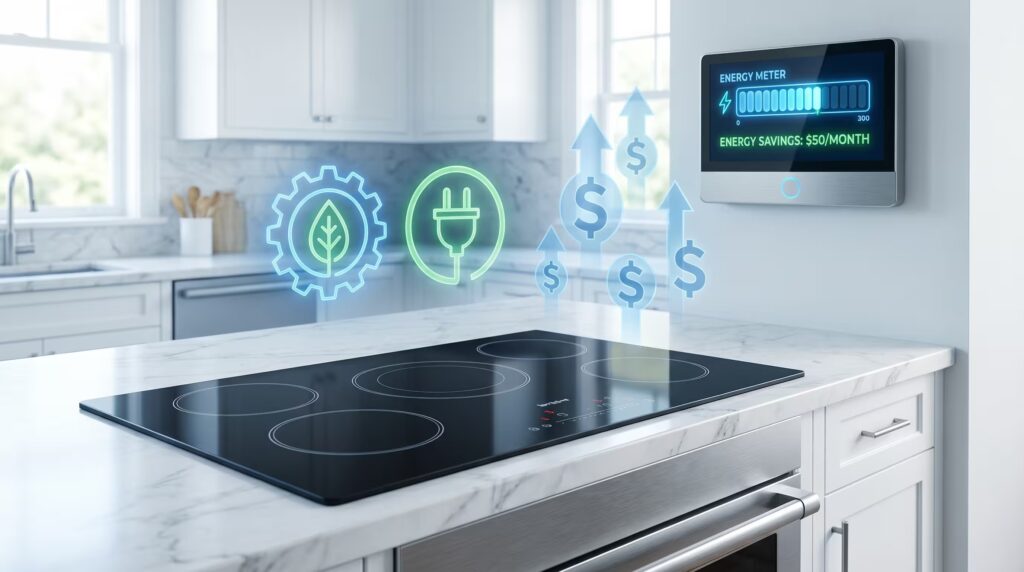
Induction, on the other hand, uses electromagnetic energy to turn the pan itself into the heat source. According to 2026 laboratory tests, induction cooktops are 85-90% energy efficient, compared to just 65-75% for traditional gas or electric models .
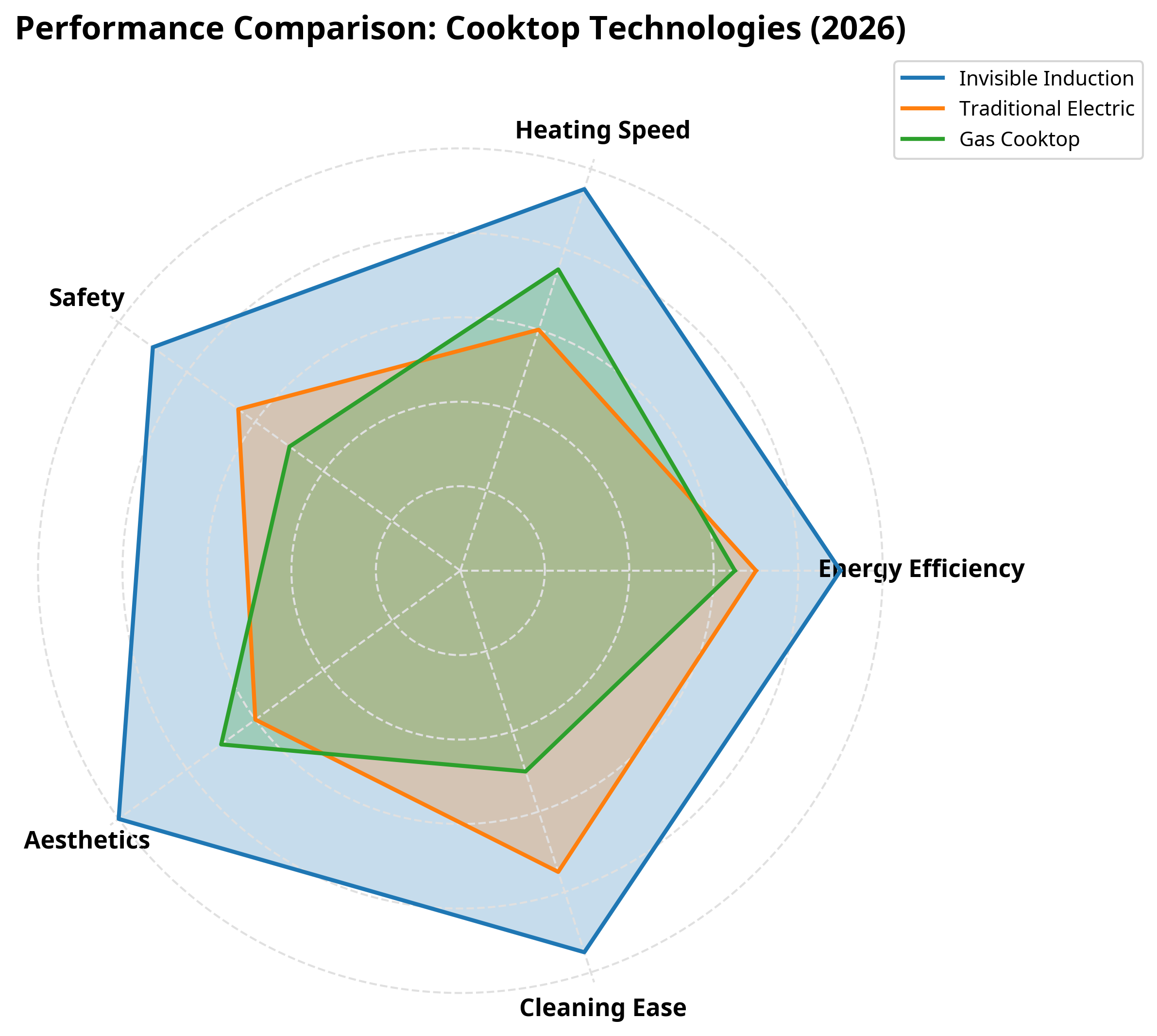
A radar chart comparing the performance of invisible induction, traditional electric, and gas cooktops across key metrics.
The Battle of the Burners
If you are debating between an induction cooktop or electric, consider these critical factors:
Feature
Invisible Induction
Traditional Electric
Gas Cooktop
Heating Speed
Extremely Fast (Boils water in < 2 mins)
Slow (Takes 4-6 mins)
Moderate (Takes 3-5 mins)
Energy Efficiency
85-90%
70-75%
65-70%
Safety
Highest (Surface stays cool)
Moderate (Surface stays hot)
Lowest (Open flame)
Aesthetics
Completely seamless
Visible glass/coils
Bulky grates
Cookware Needed
Magnetic only (Stainless/Cast Iron)
Any material
Any material
While a standard 30 inch electric cooktop or a general electric profile cooktop might have a lower upfront cost, the long-term energy savings and unparalleled aesthetic of an invisible system make it the superior choice for luxury renovations.
The most common question homeowners ask is regarding the invisible induction cooktop price. Because this is a premium, integrated technology, the costs are higher than buying a standalone appliance.
Here is what you can expect to pay in 2026:
Hardware Costs
•Two Burner Electric Cooktop (Invisible): $1,200 – $1,700
•Standard 4-Burner System: $2,500 – $3,200
•Premium 5-Burner System: $3,500 – $4,500+
Installation and Countertop Requirements
You cannot install an invisacook invisible induction cooktop under just any material. It requires specific 12mm porcelain or ultra-compact surfaces (like Dekton or XTONE) that can withstand thermal shock .
•Compatible Countertop Slab: $2,000 – $4,000
•Professional Installation: $500 – $1,500
Total Estimated Investment: $4,200 – $9,000+
While this is a significant investment compared to the best electric cooktops on the market, it effectively eliminates the need for a separate appliance cutout and provides a stunning, minimalist aesthetic that significantly boosts home resale value.
Ventilation: Solving the Hood Dilemma
A common misconception is that because the cooktop is invisible, you do not need ventilation. This is false. Cooking still produces grease, steam, and odors.
For a truly minimalist look, many designers pair invisible cooktops with a ventless cooktop hood or a downdraft electric cooktop system. A jenn air downdraft electric cooktop is a popular traditional alternative, but for invisible systems, ceiling-flush extractors or pop-up downdraft vents that retract into the counter are the preferred solutions.
Whether you choose a cooktop with rangehood or a sleek downdraft system, proper ventilation remains essential for indoor air quality.
Choosing the Right Cookware
To use any induction system, you need the best pans for electric cooktop induction. The rule is simple: if a magnet sticks to the bottom of the pan, it will work.
Compatible Materials:
•Stainless Steel (most types)
•Cast Iron
•Enameled Cast Iron (like Le Creuset)
Incompatible Materials:
•Aluminum (unless it has a magnetic base plate)
•Copper
•Glass or Ceramic
If you are upgrading from a stainless steel electric cooktop or a gas cooktop and rangehood, you may need to budget for a new set of induction-ready cookware.
Is an Invisible Cooktop Right for You?
If you are designing a modern, open-concept kitchen and want the absolute cutting edge in both design and performance, an invisible induction cooktop is unmatched. It offers the speed and precision of the best electric cooktop models, the safety of induction, and an aesthetic that traditional appliances simply cannot replicate.
However, if you are on a strict budget or prefer the tactile feedback of a general electric cooktop or a standard 36 electric cooktop, traditional induction or high-end electric models remain excellent choices.
Is an invisible induction cooktop safe to touch while cooking?
Yes. The induction technology heats the magnetic cookware directly, not the countertop surface. While the counter will absorb some residual heat from the hot pan, it will not cause severe burns like a traditional electric coil or gas flame.
Can I install an invisible cooktop under quartz or granite?
No. Natural stones like granite and standard quartz contain resins and natural fissures that can crack under the localized thermal stress. You must use approved 12mm porcelain or ultra-compact sintered stone surfaces (like Dekton).
How does the invisible induction cooktop price compare to a standard 36 inch electric cooktops?
A high-end traditional 36 inch electric cooktops or electric range with induction cooktop typically costs between $1,500 and $3,500. An invisible system of the same size will cost $3,000 to $4,500 for the hardware alone, plus the cost of the specialized countertop and professional installation.
Do I still need a range hood with an invisible cooktop?
Absolutely. While the cooktop itself does not produce combustion gases like a gas stove, the food you cook still releases steam, grease, and odors. You will need a ceiling-mounted hood, a pop-up downdraft vent, or a high-quality ventless cooktop hood system.
What happens if the invisible cooktop breaks? Do I have to replace the whole counter?
No. The induction units are mounted underneath the countertop. If a unit fails, a technician can access it from the cabinetry below to repair or replace the hardware without damaging or removing your porcelain countertop.
Resposta Rápida: An invisible induction cooktop is a sleek, flush-mounted cooking surface that integrates induction technology beneath a seamless countertop, enabling precise heat control without visible burners. This innovation maximizes kitchen aesthetics and usability by providing a minimalist design and enhanced safety. It transforms kitchens by merging advanced cooktop technology with contemporary interior design for a streamlined cooking experience.
The evolution of kitchen appliances consistently aligns with the dual demands of advanced functionality and aesthetic refinement. Within the realm of cooktops, the advent of the invisible induction cooktop epitomizes this fusion by incorporating induction heating technology beneath a continuous countertop surface, rendering the cooktop nearly imperceptible. This design innovation is not merely a stylistic choice but a technical breakthrough that redefines how kitchens are conceptualized and utilized.
In contemporary kitchen design, especially in markets such as Brazil where spatial efficiency and modern aesthetics are increasingly prioritized, the invisible induction cooktop emerges as a transformative element. It addresses complex challenges faced by kitchen professionals, architects, and homeowners alike: how to integrate powerful cooking technology without compromising on space, safety, or style. Through a deep dive into its technical characteristics, operational principles, and impact, this article serves as the definitive resource on what an invisible induction cooktop is and how it fundamentally transforms kitchens.
Adopting this cooktop technology offers a paradigm shift in kitchen ergonomics and design philosophy. The invisible induction cooktop leverages electromagnetic principles to deliver rapid, precise heating while maintaining a flat, uninterrupted surface that simplifies cleaning and enhances safety. In the following sections, readers will uncover detailed technical insights, practical implementation strategies, and an expert perspective on the broader implications of this innovation within the cooktop ecosystem.
Understanding this technology also involves recognizing its interplay with other kitchen systems and design trends. For instance, the integration of smart home platforms and energy efficiency frameworks complements the invisible induction cooktop’s capabilities, reinforcing its role as a keystone in the modern kitchen. This article includes cross-references to relevant standards and scientific resources to validate and expand on the technical concepts discussed.
Invisible Induction Cooktop: A Technical Definition and Operational Context
Invisible induction cooktop is a cooking device that employs electromagnetic induction heating elements embedded beneath a smooth, flush-mounted surface, designed to remain visually unobtrusive within the kitchen workspace, allowing efficient heat transfer without exposed burners or panels. It serves both functional cooking and aesthetic integration purposes, enabling seamless countertop continuity and enhanced safety.
Technically, the invisible induction cooktop utilizes copper coils beneath a durable glass-ceramic surface. When activated, alternating current passes through these coils generating an oscillating magnetic field. This field induces eddy currents directly in compatible ferromagnetic cookware, producing heat precisely where it is required while leaving the cooktop surface relatively cool. Unlike traditional electric or gas cooktops, this method markedly reduces energy waste and enhances user safety by eliminating open flames or radiant heat.
Integrating the invisible cooktop requires precise engineering tolerances in countertop materials and installation methods, particularly regarding thermal resistance and electromagnetic shielding. The flush integration demands collaboration between appliance manufacturers, cabinet fabricators, and installers to ensure both performance and durability. In Brazilian kitchen contexts, where countertop materials like quartz and granite are prevalent, modifications to standard installation protocols are necessary to accommodate the invisible induction technology.
The invisible induction cooktop aligns with global trends toward minimalism and smart kitchen design. It complements digital control interfaces, touch sensors, and connectivity features that enable seamless interaction with home automation systems. This integration supports energy monitoring and adaptive cooking algorithms, which are increasingly valued in both residential and commercial kitchen environments.
Core Technical Components and Their Roles in Invisible Induction Cooktops
A comprehensive understanding of the invisible induction cooktop demands an analysis of its fundamental components and their technical interplay:
1. Induction Coils and Electromagnetic Field Generation
The heart of the invisible induction cooktop is the set of induction coils constructed from high-purity copper wire, designed to generate a strong, oscillating magnetic field at frequencies typically between 20-50 kHz. These coils are embedded beneath the countertop surface, often insulated and cooled to maintain operational efficiency and longevity. The precise coil geometry and spacing influence cooking zone size and heat distribution uniformity.
This component suits professional chefs and kitchen designers seeking precise thermal control with minimal surface heat. Its strength lies in rapid heat generation directly within compatible cookware, reducing thermal lag and energy loss.
2. Glass-Ceramic Surface and Countertop Integration
The visible surface of the invisible induction cooktop is a specialized glass-ceramic material engineered for high thermal shock resistance, electromagnetic transparency, and mechanical durability. It must maintain a perfectly flush installation with surrounding countertop materials, requiring precision fabrication and installation techniques. This design ensures the cooktop remains visually and tactilely indistinguishable from the rest of the countertop.
Ideal for architects and kitchen remodelers prioritizing seamless design. The surface’s resistance to scratches and stains complements the cooktop’s low-profile aesthetic.
3. Power Electronics and Control Systems
Power inverters and control electronics modulate the induction current, enabling dynamic temperature adjustments and safety features such as automatic shutoff and pan detection. Advanced models incorporate microcontrollers and user interfaces that integrate with smart home ecosystems, allowing remote monitoring and energy consumption optimization.
Best suited for tech-savvy users and commercial kitchens requiring precise, programmable cooking profiles. Its advanced control enhances energy efficiency and user safety.
4. Safety and Sensor Technology
Sensors embedded within the cooktop monitor pan presence, temperature, and surface conditions to prevent accidents and optimize performance. For example, temperature sensors prevent overheating of the glass-ceramic surface, while pan detection ensures that heating is activated only when suitable cookware is present.
Critical for households with children and professional environments focused on compliance with safety regulations. These sensors significantly reduce burn risks and energy waste.
5. Installation and Compatibility Considerations
The invisible induction cooktop requires specific countertop thickness and materials to maintain electromagnetic efficiency and thermal management. Compatibility with existing cabinetry and ventilation systems must be evaluated during design and installation phases to ensure proper heat dissipation and electrical supply adequacy.
Relevant for installers and kitchen planners managing retrofits or new builds. Proper integration prevents performance degradation and enhances system lifespan.
How Invisible Induction Cooktops Redefine Kitchen Functionality and Design
The invisible induction cooktop transcends traditional appliance roles by merging seamlessly into kitchen architecture, offering distinctive advantages that redefine kitchen functionality:
Maximized Surface Continuity and Aesthetic Minimalism
By eliminating visible burners and controls, these cooktops create an uninterrupted surface that expands usable workspace and simplifies cleaning. This minimalist design aligns with contemporary architectural trends favoring clean lines and integrated appliances.
Enhanced Thermal Efficiency and Cooking Precision
Energy transfer efficiency in induction cooktops is superior to gas or radiant electric models, as heat is generated directly in the cookware. The invisible induction cooktop maintains this efficiency while enhancing precision through advanced control systems that adjust power levels instantaneously.
Improved Safety and User Comfort
The reduced surface temperature and absence of open flames significantly lower burn risks and improve indoor air quality by eliminating combustion byproducts. Additionally, the flush surface reduces trip hazards and facilitates accessibility, especially in compact kitchens.
Integration with Smart Kitchen Ecosystems
Modern invisible induction cooktops often feature connectivity protocols such as Wi-Fi or Bluetooth, allowing integration with kitchen management apps and smart home platforms. This integration supports energy monitoring, predictive maintenance, and personalized cooking presets.
Technical Challenges and Solutions in Implementing Invisible Induction Cooktops
The sophisticated nature of invisible induction cooktops presents several technical challenges that require expert solutions to ensure optimal performance and durability:
Material Compatibility and Electromagnetic Interference
Ensuring countertop materials do not interfere with electromagnetic fields necessitates strict selection criteria, often limiting material choices to glass-ceramic composites or engineered stone. Shielding techniques and coil design optimization mitigate electromagnetic interference with nearby electronics.
Thermal Management in Flush Installations
Because the induction coils are embedded just beneath the countertop, managing heat dissipation is critical to prevent damage to cabinetry and surrounding materials. Active cooling systems or heat sinks are often integrated to maintain temperature control.
Installation Precision and Structural Integrity
Achieving a perfectly flush surface demands millimeter-level precision during installation. Structural reinforcements in cabinetry may be necessary to support the cooktop and prevent warping or cracking under thermal stress.
Electrical Requirements and Safety Standards Compliance
Invisible induction cooktops often require dedicated electrical circuits with specific voltage and amperage ratings. Compliance with national safety standards, such as IEC or Brazilian ABNT regulations, is mandatory, involving rigorous testing and certification processes.
Comparative Analysis: Invisible Induction Cooktop Versus Traditional Cooktops
Feature
Invisible Induction Cooktop
Traditional Gas Cooktop
Electric Radiant Cooktop
Surface Design
Flush, seamless countertop integration
Raised burners with grates
Raised elements with glass surface
Heat Source
Electromagnetic induction
Open flame combustion
Resistive heating elements
Energy Efficiency
High (direct cookware heating)
Low to medium (heat loss via flame)
Medium (surface heating)
Safety
Cool surface, no open flame
Open flame, combustion gases
Hot surface, burn risk
Cleaning
Easy, flat surface
Complex, grates and burners
Moderate, flat but hot surface
Installation Complexity
High (precise flush fit required)
Moderate (gas line and ventilation)
Moderate (electrical hookup)
Control Precision
High, instant power modulation
Variable, less precise
Moderate, slow heat changes
Checklist for Selecting and Installing an Invisible Induction Cooktop
Confirm countertop material compatibility with induction technology.
Ensure electrical system supports required voltage and amperage.
Verify cabinet structure can support flush installation without warping.
Choose cookware compatible with induction heating (ferromagnetic base).
Integrate cooling systems to manage heat dissipation.
Plan for precise measurements to achieve seamless surface alignment.
Inspect electromagnetic shielding to prevent interference with other devices.
Confirm compliance with local safety and installation standards.
Evaluate smart connectivity features for integration with home systems.
Arrange professional installation by qualified technicians.
Implement user training on operation and safety protocols.
Tip: When selecting an invisible induction cooktop, prioritize models with advanced sensor arrays for pan detection and temperature control to maximize safety and energy efficiency.
Attention: Improper installation can lead to electromagnetic interference affecting nearby electronic devices; always ensure compliance with installation guidelines and electromagnetic compatibility standards.
Common Mistake: Assuming all cookware is compatible; only ferromagnetic materials induce heat effectively in induction cooktops, so non-magnetic pots and pans will not heat.
What is the primary difference between an invisible induction cooktop and a standard induction cooktop?
The invisible induction cooktop is integrated flush beneath the countertop surface, rendering it nearly imperceptible, while a standard induction cooktop has a visible cooking surface with defined zones and controls.
How does the invisible induction cooktop improve kitchen safety?
It uses electromagnetic induction to heat cookware directly, keeping the cooktop surface cool to the touch and eliminating open flames, substantially reducing burn risks and fire hazards.
Can any type of cookware be used with an invisible induction cooktop?
No, only ferromagnetic cookware such as cast iron or stainless steel with magnetic bases are compatible because induction heating relies on magnetic fields to generate heat.
What are the installation requirements for an invisible induction cooktop?
Installation requires a compatible countertop material, precise flush mounting, adequate electrical supply, and often structural reinforcement to manage heat and maintain surface integrity.
How does an invisible induction cooktop impact energy efficiency in the kitchen?
It improves energy efficiency by directly heating the cookware through induction, minimizing heat loss to the environment and reducing overall cooking energy consumption compared to gas or electric radiant cooktops.
Is the invisible induction cooktop compatible with smart home systems?
Many modern invisible induction cooktops feature connectivity options such as Wi-Fi or Bluetooth, allowing integration with smart home platforms for remote control and energy monitoring.
What maintenance does an invisible induction cooktop require?
Maintenance mainly involves cleaning the smooth surface with non-abrasive cleaners and ensuring ventilation areas remain unobstructed to prevent overheating of internal components.
Does the invisible induction cooktop require special ventilation?
While induction cooktops generate less heat and no combustion gases, proper ventilation is still advised to dissipate residual heat and maintain appliance longevity.
Implementing an Invisible Induction Cooktop: Practical Steps for Professionals
Implementing an invisible induction cooktop involves meticulous planning and execution. Below are the recommended steps:
Assess Countertop Material Compatibility: Confirm the existing or planned countertop supports electromagnetic transparency and thermal resistance, such as glass-ceramic or engineered stone.
Electrical System Evaluation: Ensure the kitchen’s electrical infrastructure can provide the dedicated circuit with appropriate amperage and voltage for the cooktop.
Precise Measurement and Layout Planning: Collaborate with cabinetmakers and appliance providers to determine exact dimensions for a flush fit and seamless integration.
Structural Reinforcement: Modify cabinetry as needed to support the cooktop’s weight and thermal management requirements.
Install Electromagnetic Shielding: Implement shielding solutions to prevent interference with nearby electronics and comply with regulatory standards.
Professional Installation: Engage certified technicians specializing in induction technology for installation and calibration.
Testing and Calibration: Conduct comprehensive functional tests, including pan detection, heating uniformity, and safety features.
User Training: Provide detailed operational guidance to end-users emphasizing compatible cookware and safety protocols.
The estimated time for installation ranges from one to three days depending on the complexity of integration and kitchen modifications. While the difficulty level is high due to precision demands, adherence to these steps ensures optimal performance and long-term reliability.
Final Perspective: The Invisible Induction Cooktop as the Future of Kitchen Innovation
The invisible induction cooktop embodies a synthesis of cutting-edge electromagnetic heating technology and refined kitchen design principles, representing a critical step forward in transforming culinary environments. Its capacity to deliver precise, efficient heat while maintaining an uninterrupted countertop surface not only elevates kitchen aesthetics but also enhances safety and usability.
By leveraging advanced components such as high-efficiency induction coils, robust glass-ceramic surfaces, and intelligent control electronics, this cooktop type addresses longstanding challenges in kitchen appliance integration. The technical sophistication required in its installation and operation underscores the importance of specialized knowledge and collaboration among appliance manufacturers, designers, and installers.
In the Brazilian context and globally, where consumers increasingly demand sustainable, smart, and space-optimized kitchens, the invisible induction cooktop offers a compelling solution. It aligns with standards and trends focusing on energy efficiency, electromagnetic compatibility, and seamless smart home integration, positioning itself as a cornerstone technology in modern kitchen ecosystems.
Ultimately, adopting an invisible induction cooktop is not merely about upgrading a cooking surface but about embracing a holistic kitchen transformation that balances form, function, and future-ready innovation. Professionals and homeowners invested in the highest standards of kitchen performance and design will find this technology indispensable in achieving those goals.
For further technical reading on electromagnetic induction principles and kitchen appliance standards, refer to authoritative resources such as the IEEE and W3C.
The battle between induction and gas cooktops has never been more relevant. In 2026, more American homeowners are making the switch to induction than ever before, driven by energy efficiency, safety concerns, and superior cooking performance. But is induction really better than gas? Or is the traditional gas cooktop still the king of the kitchen?
This comprehensive guide breaks down every aspect of both technologies, backed by real-world testing data and expert analysis, so you can make an informed decision for your home.
Induction cooktops use electromagnetic technology to generate heat directly in your cookware. When you place a magnetic pan on the cooktop, electromagnetic coils beneath the surface create a magnetic field that causes the metal molecules in the pan to vibrate rapidly, generating heat almost instantaneously.
The key advantage? The cooktop surface itself remains relatively cool. Only the pan heats up. This is fundamentally different from gas, where an open flame heats both your cookware and the surrounding air.
How Gas Cooktops Work
Gas cooktops ignite natural gas or propane through a burner, creating an open flame that heats your cookware directly. The flame is visible, controllable, and has been the standard in professional kitchens for decades.
Gas cooktops require a gas line connection and proper ventilation, but they offer immediate heat adjustment and work with any type of cookware.
Speed: Induction Wins Decisively
In laboratory tests conducted in 2026, induction cooktops consistently outperform gas cooktops in heating speed. The Bosch 800 Series induction cooktop brought 6 cups of water to a rolling boil in just 1 minute 42 seconds, while comparable gas cooktops took 2-3 minutes.
This 30-40% speed advantage means faster meal preparation and more efficient cooking overall. For busy families, this difference adds up to significant time savings over the course of a year.
Energy Efficiency: Induction Dominates
Induction cooktops are roughly 85-90% energy efficient, meaning 85-90 cents of every dollar you spend on electricity goes directly into cooking. Gas cooktops, by contrast, are only 65-75% efficient because much of the heat escapes into the surrounding air.
The real-world impact? An average induction cooktop costs approximately $34-60 per year to operate, compared to $26-52 for gas. While induction is slightly more expensive to run, the difference is minimal—about $1-2 per month—and the superior cooking performance often justifies the cost.
Safety Considerations
Induction Safety Advantages:
•No open flame means no risk of accidental burns from the burner itself
•The cooktop surface only gets as hot as the pan on top of it
•Automatic shutoff if cookware is removed
•No carbon monoxide risk
•Better for homes with children or pets
Gas Safety Concerns:
•Open flame poses burn risk
•Requires proper ventilation to prevent carbon monoxide buildup
•Gas leaks are a potential hazard
•Less forgiving if cookware tips over
Modern gas cooktops have safety features like flame failure devices, but induction remains the safer choice overall.
Cooking Performance: It Depends on Your Style
Induction Excels At:
•Precise temperature control for delicate sauces and melting chocolate
•Rapid boiling and heating
•Consistent, even heat distribution
•Quick adjustments to temperature
Gas Excels At:
•High-heat searing and charring
•Wok-style cooking with movement
•Visual flame feedback
•Works with any cookware immediately
Professional chefs often prefer gas for its responsiveness and high-heat capabilities, but home cooks typically find induction more forgiving and easier to control.
Cost Comparison
Factor
Induction
Gas
Upfront Cost
$800-$3,000+
$600-$2,500
Installation
$500-$1,500 (electrical)
$300-$800 (gas line)
Annual Operating Cost
$34-60
$26-52
Cookware Compatibility
Magnetic only
Any cookware
Maintenance
Minimal
Regular cleaning
Cookware Compatibility
This is where gas has a clear advantage. Gas cooktops work with any cookware—stainless steel, copper, aluminum, cast iron, ceramic. If you have an existing collection of cookware, gas requires no changes.
Induction cooktops require cookware with a magnetic base. Most modern stainless steel and cast iron pans work, but aluminum and copper cookware won’t. You can test your pans with a magnet; if it sticks to the bottom, it’s induction-compatible.
Ventilation and Installation
Gas cooktops require a dedicated gas line and proper ventilation to safely exhaust combustion byproducts. This often means installing or upgrading a range hood, which adds to installation costs.
Induction cooktops require only a standard electrical outlet (or hardwired connection for built-in models). They don’t produce combustion byproducts, so ventilation requirements are less stringent, though a range hood is still recommended for steam and cooking odors.
The Verdict: Which Should You Choose?
Choose Induction If:
•You prioritize speed and energy efficiency
•Safety is a top concern
•You want precise temperature control
•You’re willing to replace cookware if needed
•You have a modern kitchen with good electrical infrastructure
Choose Gas If:
•You do high-heat cooking or wok-style cooking frequently
•You already have a large collection of cookware
•You prefer the visual feedback of a flame
•You want lower upfront costs
•You live in an area with unreliable electricity
For most American homeowners in 2026, induction represents the future of cooking. It’s faster, safer, more efficient, and offers superior control. However, gas remains an excellent choice for those who prioritize high-heat cooking or have specific cooking styles that benefit from an open flame.
Can I use my existing pans on an induction cooktop?
Only if they have a magnetic base. Most stainless steel and cast iron pans work, but aluminum and copper won’t. Test with a magnet first.
Is induction cooktop radiation dangerous?
No. Induction cooktops emit non-ionizing radiation similar to radio waves. The magnetic field is contained within the cooktop and poses no health risk.
How much does it cost to install an induction cooktop?
Installation typically costs $500-$1,500, depending on your electrical infrastructure. Gas installation runs $300-$800.
Do induction cooktops work during power outages?
No. Induction cooktops require electricity to operate. Gas cooktops can still function (though electronic ignition may not work).
Which cooktop is better for resale value?
Induction cooktops are increasingly viewed as a premium feature and can add value to your home. Gas cooktops are still desirable but less trendy.
Can I have both induction and gas in the same kitchen?
Yes. Many high-end kitchens feature hybrid cooktops with both induction and gas burners for maximum versatility.