
The battle between induction and gas cooktops has never been more relevant. In 2026, more American homeowners are making the switch to induction than ever before, driven by energy efficiency, safety concerns, and superior cooking performance. But is induction really better than gas? Or is the traditional gas cooktop still the king of the kitchen?
This comprehensive guide breaks down every aspect of both technologies, backed by real-world testing data and expert analysis, so you can make an informed decision for your home.
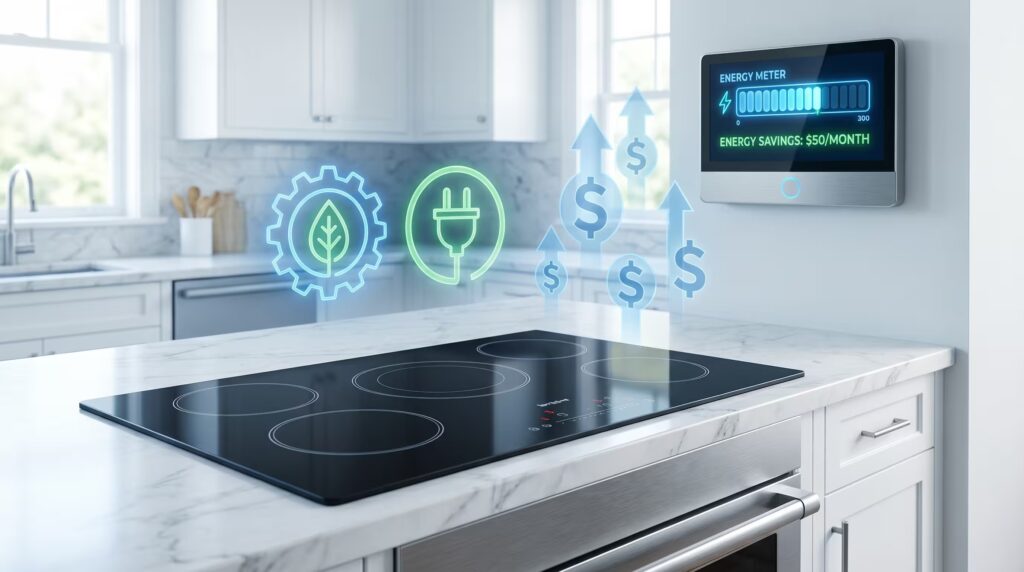
How Induction Cooktops Work
Induction cooktops use electromagnetic technology to generate heat directly in your cookware. When you place a magnetic pan on the cooktop, electromagnetic coils beneath the surface create a magnetic field that causes the metal molecules in the pan to vibrate rapidly, generating heat almost instantaneously.
The key advantage? The cooktop surface itself remains relatively cool. Only the pan heats up. This is fundamentally different from gas, where an open flame heats both your cookware and the surrounding air.
How Gas Cooktops Work
Gas cooktops ignite natural gas or propane through a burner, creating an open flame that heats your cookware directly. The flame is visible, controllable, and has been the standard in professional kitchens for decades.
Gas cooktops require a gas line connection and proper ventilation, but they offer immediate heat adjustment and work with any type of cookware.
Speed: Induction Wins Decisively
In laboratory tests conducted in 2026, induction cooktops consistently outperform gas cooktops in heating speed. The Bosch 800 Series induction cooktop brought 6 cups of water to a rolling boil in just 1 minute 42 seconds, while comparable gas cooktops took 2-3 minutes.
This 30-40% speed advantage means faster meal preparation and more efficient cooking overall. For busy families, this difference adds up to significant time savings over the course of a year.
Energy Efficiency: Induction Dominates
Induction cooktops are roughly 85-90% energy efficient, meaning 85-90 cents of every dollar you spend on electricity goes directly into cooking. Gas cooktops, by contrast, are only 65-75% efficient because much of the heat escapes into the surrounding air.
The real-world impact? An average induction cooktop costs approximately $34-60 per year to operate, compared to $26-52 for gas. While induction is slightly more expensive to run, the difference is minimal—about $1-2 per month—and the superior cooking performance often justifies the cost.
Safety Considerations
Induction Safety Advantages:
•No open flame means no risk of accidental burns from the burner itself
•The cooktop surface only gets as hot as the pan on top of it
•Automatic shutoff if cookware is removed
•No carbon monoxide risk
•Better for homes with children or pets
Gas Safety Concerns:
•Open flame poses burn risk
•Requires proper ventilation to prevent carbon monoxide buildup
•Gas leaks are a potential hazard
•Less forgiving if cookware tips over
Modern gas cooktops have safety features like flame failure devices, but induction remains the safer choice overall.
Cooking Performance: It Depends on Your Style
Induction Excels At:
•Precise temperature control for delicate sauces and melting chocolate
•Rapid boiling and heating
•Consistent, even heat distribution
•Quick adjustments to temperature
Gas Excels At:
•High-heat searing and charring
•Wok-style cooking with movement
•Visual flame feedback
•Works with any cookware immediately
Professional chefs often prefer gas for its responsiveness and high-heat capabilities, but home cooks typically find induction more forgiving and easier to control.
Cost Comparison
| Factor | Induction | Gas |
| Upfront Cost | $800-$3,000+ | $600-$2,500 |
| Installation | $500-$1,500 (electrical) | $300-$800 (gas line) |
| Annual Operating Cost | $34-60 | $26-52 |
| Cookware Compatibility | Magnetic only | Any cookware |
| Maintenance | Minimal | Regular cleaning |
Cookware Compatibility
This is where gas has a clear advantage. Gas cooktops work with any cookware—stainless steel, copper, aluminum, cast iron, ceramic. If you have an existing collection of cookware, gas requires no changes.
Induction cooktops require cookware with a magnetic base. Most modern stainless steel and cast iron pans work, but aluminum and copper cookware won’t. You can test your pans with a magnet; if it sticks to the bottom, it’s induction-compatible.
Ventilation and Installation
Gas cooktops require a dedicated gas line and proper ventilation to safely exhaust combustion byproducts. This often means installing or upgrading a range hood, which adds to installation costs.
Induction cooktops require only a standard electrical outlet (or hardwired connection for built-in models). They don’t produce combustion byproducts, so ventilation requirements are less stringent, though a range hood is still recommended for steam and cooking odors.
The Verdict: Which Should You Choose?
Choose Induction If:
•You prioritize speed and energy efficiency
•Safety is a top concern
•You want precise temperature control
•You’re willing to replace cookware if needed
•You have a modern kitchen with good electrical infrastructure
Choose Gas If:
•You do high-heat cooking or wok-style cooking frequently
•You already have a large collection of cookware
•You prefer the visual feedback of a flame
•You want lower upfront costs
•You live in an area with unreliable electricity
For most American homeowners in 2026, induction represents the future of cooking. It’s faster, safer, more efficient, and offers superior control. However, gas remains an excellent choice for those who prioritize high-heat cooking or have specific cooking styles that benefit from an open flame.
FAQ: Induction vs Gas Cooktops
Can I use my existing pans on an induction cooktop?
Only if they have a magnetic base. Most stainless steel and cast iron pans work, but aluminum and copper won’t. Test with a magnet first.
Is induction cooktop radiation dangerous?
No. Induction cooktops emit non-ionizing radiation similar to radio waves. The magnetic field is contained within the cooktop and poses no health risk.
How much does it cost to install an induction cooktop?
Installation typically costs $500-$1,500, depending on your electrical infrastructure. Gas installation runs $300-$800.
Do induction cooktops work during power outages?
No. Induction cooktops require electricity to operate. Gas cooktops can still function (though electronic ignition may not work).
Which cooktop is better for resale value?
Induction cooktops are increasingly viewed as a premium feature and can add value to your home. Gas cooktops are still desirable but less trendy.
Can I have both induction and gas in the same kitchen?
Yes. Many high-end kitchens feature hybrid cooktops with both induction and gas burners for maximum versatility.
Leave a Reply